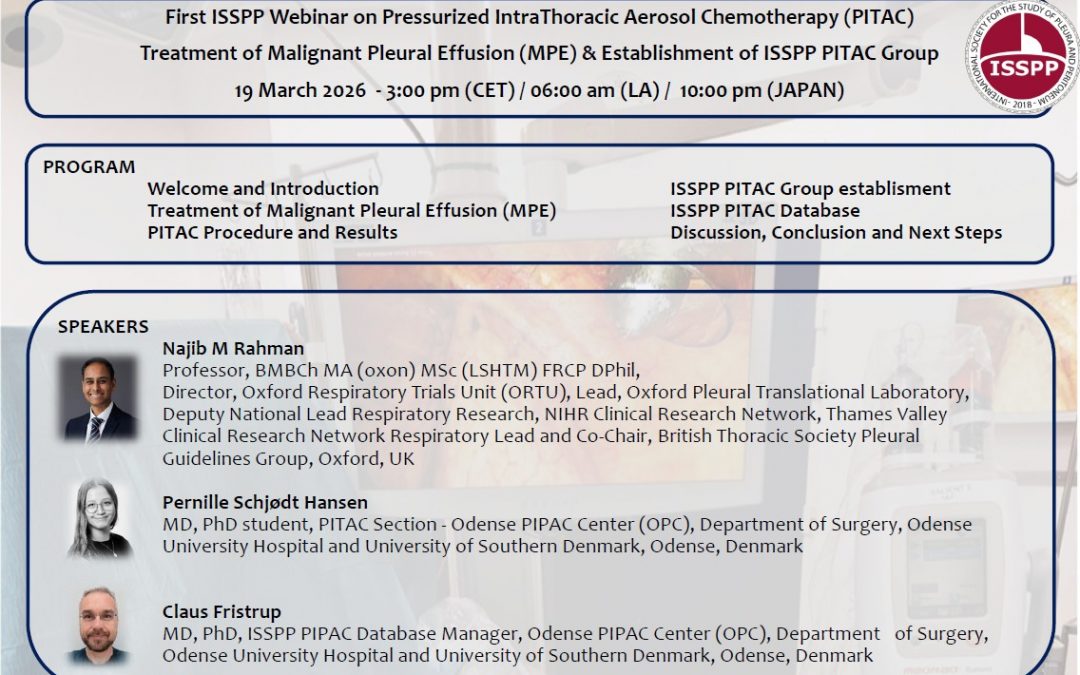
Preliminary data have suggested that PITAC is technically feasible and safe in patients with Malignant Pleural Effusion (MPE) and pleural metastasis (PLM). However, PITAC has only reached the IDEAL stage 2a and much work and research lie ahead. To stimulate general interest in PITAC directed treatment of MPE the first ISSPP Webinar on PITAC, hosted by Odense PIPAC Center, was held successfully on the 19th of March 2026. More than 50 people with different clinical backgrounds and from different continents participated in the webinar.
The Webinar was divided into two sections. The first was dedicated to an overview of the present treatment of MPE followed by a presentation of the PITAC technique and preliminary data. The second part was dedicated to the establishment of a dedicated ISSPP PITAC Group.
After a short introduction, Professor Najib M Rahman, Director of the Oxford Respiratory Trials Unit (ORTU) presented an excellent overview of the current treatment of MPE. It was clearly stated that malignant pleural effusion increases the resistance to systemic chemotherapy and stimulates further growth of cancer cells. Therefore, a more aggressive and lasting treatment approach to MPE is needed, and PITAC may add to the individualized treatment strategies in these severely ill patients.
A review of the currently available PITAC results was given by Dr. Pernille Schjødt Hansen, PhD student at Odense PIPAC Center, with special focus on PITAC rationale, indications, step-by-step technique, and outcomes. One of the key points from her presentation was the lack of international consensus on pre-operative examination, patient selection, PITAC technique, post-operative evaluation, response evaluation and follow-up. Taking this into account, a DELPHI study will soon be announced on the ISSPP homepage and PIPAC.dk, and all PITAC surgeons are invited to participate in the survey.
The second part of the webinar was dedicated to the establishment of an ISSPP PITAC Group. Professor Michael Bau Mortensen presented the list of potential stakeholders – including patients and relatives, and a plan for the structure and tasks of an ISSPP endorsed PITAC Group. To get more early clinical data on PITAC safety and efficacy it was also proposed to initiate work on a dedicated PITAC database embedded in the ongoing ISSPP PIPAC database. Dr. Claus Fristrup (Database Manager) presented the status of the ISSPP PIPAC database and the potential use of a dedicated subsection for PITAC reporting.
The webinar underlined that MPE patients still have unmet needs in terms of symptom relief, and that new, individualized treatment strategies should be pursued. Preliminary PITAC experience in MPE patients suggests that the procedure is safe and well tolerated, and that this treatment platform should be further investigated. The webinar group and ISSPP ExCo are planning the next steps towards the establishment of a dedicated ISSPP PITAC Group. Details of this plan will be available during the 5th ISSPP Congress in Brazil.